FAQ - On-Premise
- Deployment (broadcasting)
- Remote Maintenance & Getting Started
- FLUX Test
- Firewall
- IMAGING Prerequisites
- Active Directory
- I already have a PXE server on my network. Is that a problem?
- Simplified flowchart of Medulla
- OIDC
- DNS and Medulla Relay views in the DMZ
- Filter machine types by GLPI ID
- Your GLPI with Read-Only User
- Disable convergence for the Extract drivers package
- Configuration Guide: OIDC Authentication and User Synchronization
- Increase the connection timeout to the interface
- Activation Support / WSUS / CVE
- Change the server's FQDN
- Change the SSH port between Server and Client
- GLPI - Connect an external GLPI
Deployment (broadcasting)
Why are my deployments stuck in Pending?
- The "Pending" status indicates that deployments will be processed shortly. If the issue persists, please contact Support or your Administrator.
Why are my deployments stuck in "Deployment Start"?
- The "Deployment Start" status indicates that deployments will be processed shortly. If the issue persists, please contact Support or your Administrator.
What should I do if I encounter a deployment error: "Abort Package Execution"?
- You should check the script associated with the package; the error indicates that it is not executing correctly. You can try running the script manually on your machine.
- Check the feedback provided by the deployment audit; this may offer clues as to the cause of the error.
What to do if a deployment error occurs: Transfer Failed?
- Your computer cannot retrieve the package due to Rsync. Please check the Rsync permissions on several folders for the pulseuser account; the permissions should be set as follows:
C:\Progra~1\Pulse\var\tmp\packages BUILTIN\Users:(OI)(CI)(F)
                                   NT SERVICE\TrustedInstaller:(I)(F)
                                   NT SERVICE\TrustedInstaller:(I)(CI)(IO)(F)
                                   NT AUTHORITY\SYSTEM:(I)(F)
                                   NT AUTHORITY\SYSTEM:(I)(OI)(CI)(IO)(F)
                                   BUILTIN\Administrators:(I)(F)
                                   BUILTIN\Administrators:(I)(OI)(CI)(IO)(F)
                                   BUILTIN\Users:(I)(RX)
                                   BUILTIN\Users:(I)(OI)(CI)(IO)(GR,GE)
                                   CREATOR OWNER:(I)(OI)(CI)(IO)(F)
                                   APPLICATION PACKAGE AUTHORITY\ALL APPLICATION PACKAGES:(I)(RX)
                                   APPLICATION PACKAGE AUTHORITY\ALL APPLICATION PACKAGES:(I)(OI)(CI)(IO)(GR,GE)
                                   APPLICATION PACKAGE AUTHORITY\ALL RESTRICTED APPLICATION PACKAGES:(I)(RX)
                                   APPLICATION PACKAGE AUTHORITY\ALL RESTRICTED APPLICATION PACKAGES:(I)(OI)(CI)(IO)(GR,GE)

C:\Users\pulseuser\.ssh NT AUTHORITY\SYSTEM:(I)(OI)(CI)(F)
                        BUILTIN\Administrators:(I)(OI)(CI)(F)
                        MACHINE_NAME\pulseuser:(I)(OI)(CI)(F)

C:\Users\pulseuser\.ssh\authorized_keys MACHINE_NAME\pulseuser:(F)
                                        NT AUTHORITY\SYSTEM:(F)
Why aren't my deployments starting, or why are they taking a long time to start?
- If your deployments are taking a long time to start, it is possible that your queued deployment is being slowed down by the current load on the SaaS platform.
- If your deployments remain stuck, please contact Support or your Administrator.
How do I stop a deployment?
- You can use the "Stop Deploy" button in the deployment audit to stop the current deployment.
How do I view the results of my deployment?
- In the "Audit" view, you can find a list of all your deployments. Click the "
 " action button to view your deployment details.
How do I restart a deployment?
- In the "Audit" view, locate the row corresponding to the deployment you want to restart, then click the action button
 to restart the deployment.
Remote Maintenance & Getting Started
What should I do if remote access (VNC/RDP/PMAD) isn't working?
- Check the TightVNC service on the affected machines.
- Remote access is not available if the computer appears offline (grayed out); if this is the case, check the status of the medullaagent service on the machine.
- If your default SSH port is not 22, ensure that the following file includes your IP address and the SSH port you are using: C:\Program Files\Medulla\bin\reversessh.bat
If this is not the case, then a change must be made on your server in the file: /etc/pulse-xmpp-agent/reverse_ssh_on.ini.local
You must restart the pulse-xmpp-agent-relay.service - If your infrastructure has a public IP address and the server cannot reach the endpoints via a private IP address or a VPN, the connection is then established in reverse from the endpoint to the server.
To verify that this connection is working properly, manually run the following script:C:\Program Files\Medulla\bin\reversessh.bat
This will allow you to identify any connection errors.
FLUX Test
Before installing Medulla, it is essential to verify the communication between:
- Your Medulla server,
- Your relay (if applicable),
- Your client machines.
To do this, we provide a includes dedicated scripts. All data flows must be successfully validated to ensure a of Medulla.
Please feel free to contact us for any assistance or clarification regarding these tests.
The scripts are available for download here:
https://dl.medulla-tech.io/nc/windows_connection_check_signed.ps1
https://dl.medulla-tech.io/nc/check_connection_ldap.sh
https://dl.medulla-tech.io/nc/check_connection_glpi.sh
(Right-click on the links below, then click "Save link as...")
Test Prerequisites
Before you begin, make sure you have downloaded the test scripts provided above and prepared the machines:
-
On the Linux servers (Medulla & Relai):
-
Install the necessary tools:
sudo apt update && sudo apt install netcat-openbsd mariadb-client ldap-utils -
Make the scripts executable:
chmod +x listen_ports_debian.sh medulla_connection_check.sh medulla_relay_connection_check.sh
dos2unix *.sh  # If necessary
-
-
On the Windows client machine with the Medulla agent:
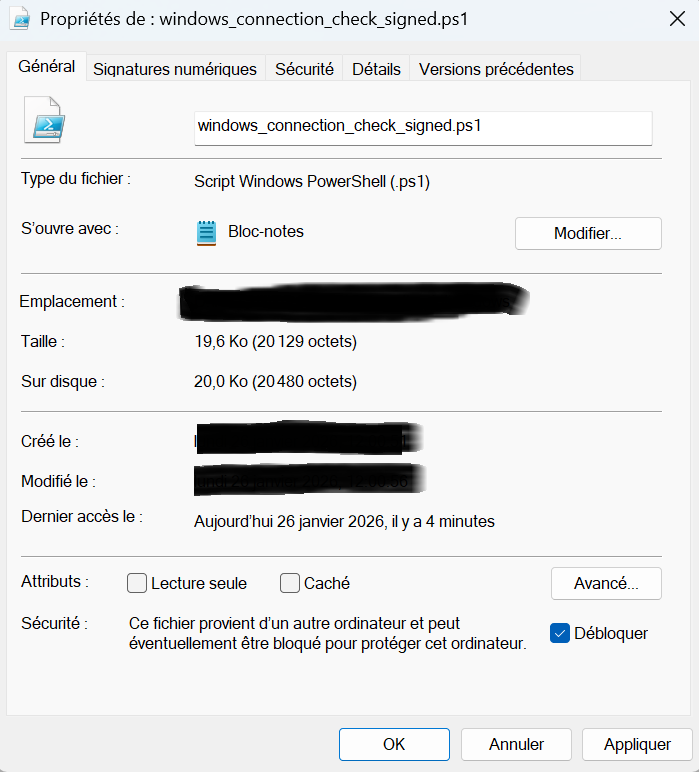
- Right-click on the script, click Properties, check the box to allow the script to run, and confirm.

- Allow PowerShell scripts to run:
Set-ExecutionPolicy -Scope CurrentUser -ExecutionPolicy RemoteSigned# Answer "Yes for all" (Y or T) if prompted
For PowerShell v7.5.4:
There is no need to unblock the script. You must run the command shown above.
It will ask if you want to allow the publisher of the script; simply confirm by clicking R or A.


1. Test Medulla Server <-> Medulla Relay
Verify communication between the main server and the relay.
Direction: Server to Relay
-
A. On the Relay Server (Destination): Start listening on the ports. (Do not perform this step if Medulla is already installed or if you are using SaaS)
./listen_ports_debian.sh -r -
B. On the Medulla Server (Source): Run the connection test.
./medulla_connection_check.sh -r <RELAY_IP>
Direction: Relay to Server
-
C. On the Medulla Server (Destination): Start listening on the ports. (Do not perform this step if Medulla is already installed or if you are using SaaS)
./listen_ports_debian.sh -m -
D. On the Relay Server (Source): Run the connection test.
./medulla_relay_connection_check.sh -m <MEDULLA_IP>
2. Medulla Server <-> Windows Client Test
Verify direct communication between the server and client workstations.
Direction: Server to Client Workstation
-
A. On the Client Workstation (Destination): Start listening.
.\listen_ports_windows.ps1 -
B. On the Medulla Server (Source): Run the test to the client’s IP address.
./medulla_connection_check.sh -c client.example.com
Direction: Client Workstation to Server
-
C. On the Medulla Server (Destination): Start listening. (Do not perform this step if Medulla is already installed or if you are using SaaS)
./listen_ports_debian.sh -m -
D. On the Client Workstation (Source): Run the test to the server's IP address.
.\windows_connection_check_signed.ps1 -Target <SERVER_IP> -Mode pulse
A log file has been created (in the location where you are running the script) that summarizes several tests, named: LOG_Test_Flux.txt
If you encounter permission errors when creating the log file, try placing the scripts in the user’s Downloads folder, or grant the windows_connection_check.ps1 script permission to create a file in the same location.
3. Medulla Relay <-> Windows Client Workstation Test
Only if the workstations need to communicate via a relay.
Direction: Relay to Client Workstation
-
A. On the Client Workstation (Destination): Start listening.
.\listen_ports_windows.ps1 -
B. On the Relay Server (Source): Run the test to the workstation’s IP address.
./medulla_relay_connection_check.sh -c client.example.com
Direction: Client Workstation to Relay
-
C. On the Relay Server (Destination): Start listening. (Do not perform this step if Medulla is already installed or if you are using SaaS)
./listen_ports_debian.sh -r -
D. On the Client Workstation (Source): Run the test to the relay's IP address.
.\windows_connection_check_signed.ps1 -Target <RELAY_IP> -Mode relay
A log file has been created (in the location where you are running the script) that summarizes several tests, named:LOG_Test_Flux.txt
If you encounter permission errors after creating the log file, try placing the scripts in the user’s Downloads folder, or grant the windows_connection_check.ps1 script permission to create a file in the same location.
4. Medulla Relay DMZ <-> Windows Mobile Client Test
Verification of direct communication between the server and client workstations.
(Mobile clients can only be reached on ports 5222 and 22)
Direction: Client Workstation to Server
-
A. On the Medulla DMZ Server (Destination): Start listening. (Do not perform this step if Medulla is already installed or if you are using SaaS)
./listen_ports_debian.sh -r -
B. On the Mobile Client (Source): Run the test to the server’s IP address.
.\windows_connection_check_signed.ps1 -Target <SERVER_IP> -Mode relay
5. Test server destined for Medulla -> Your GLPI server
Verify direct communication between the server and your GLPI server.
(Requires the mariadb-client package: apt install mariadb-client)
-
A. On the Medulla server: Run the test against the external GLPI database.
./check_connection_glpi.sh DB_FQDN DB_USERNAME DB_PASSWORD DB_NAME_GLPI
6. Server Test for Medulla -> Your LDAP Server
Verify direct communication between the server and your LDAP server.
(Requires the ldap-utils package: apt install ldap-utils)
-
A. On the Medulla server: Run the test against the external LDAP server.
./check_connection_ldap.sh HOST PORT 'BIND_DN' 'PASSWORD' 'BASE_DN'
Firewall
If a firewall is located between the server and the workstations, it is essential to ensure that the ports required for communication are open in both directions (inbound and outbound).
The following ports must be accessible:
-
22: SSH (remote access and secure transfers)
-
9: Wake-on-LAN
-
5900: VNC (remote control)
-
3389: RDP (Remote Desktop Connection)
-
35621 and 35623: Backups
-
5985 and 5986: WinRM (HTTP/HTTPS remote management)
In summary:
Verify that these ports are not blocked by the server’s firewall, client workstations, or any intermediate network equipment (router, hardware firewall, etc.).
IMAGING Prerequisites
PXE/DHCP Configuration
After installing and configuring your server, a document dedicated to setting up DHCP/PXE will be sent to you.
Imaging Workshop
Before scheduling your Imaging workshop, you need to prepare a few things:
- To create a clean image, you need a fresh Windows machine that hasn’t completed the OOBE questions.
Start the installation of a Windows machine, and when the OOBE appears, cancel it using: CTRL + SHIFT + F3
- Have a few PCs ready for deployment.
We can also provide you with masters for certain Windows models; please let us know which Windows models you wish to deploy.
Active Directory
For an on-premises deployment, three separate Active Directory service accounts must be provided.
1. Read-Only Account
This account is used to query LDAP for information about users and groups.
-
Role:
Read-Only. -
Function: Retrieves user and group information via the LDAP (or LDAPS) protocol.
-
Required Permissions: Must have the necessary rights to search and read user attributes in the Active Directory directory.
-
Location in the application: The credentials for this account will be configured in the Medulla configuration file (information requested in the delivery form).
2. Machine Enrollment Account (Imaging/Mastering)
This account is dedicated to provisioning and registering new machines in the domain during the imaging (or mastering) process.
-
Role: Rights to enroll machines in the domain.
-
Function: Allow computers to be added to the Active Directory domain.
-
Required Permissions: Must have the "Add workstations to the domain" right .
-
Process Integration: This account will be integrated and used by
Sysprepto perform the domain join operation during machine mastering.
3. Script Execution Account (Medulla Agent Installation)
This account is required for post-deployment administration tasks, specifically forthe remote installation of the Medulla agent via PowerShell, targeting a defined Organizational Unit (OU).
-
Role: List AD computers and run PowerShell scripts remotely with delegated rights.
-
Function: List computers in Active Directory. Install and configure the Medulla agent on client machines, targeting machines in a specific OU.
-
Required permissions:
-
Delegated Rights on the Target OU: Must have rights to modify
Computerobjects and rights allowing the execution of remote commands (via WinRM or an equivalent solution) on machines in the specified OU. -
Access to network share: If the Medulla agent script or installer is stored on a share, the account must have read permissions on that share.
- List AD computers: Musthave the right to list AD computers to select the computers on which the agent should be installed.
-
-
Usage: This account will be used by the Python application to initiate and validate the execution of PowerShell scripts on the machines, ensuring that the agent is installed and that the machine is correctly assigned to the correct OU structure.
I already have a PXE server on my network. Is that a problem?
Coexistence with an Existing PXE Server
The Medulla installation includes setting up a dedicated PXE (Preboot Execution Environment) server to facilitate deployment. We understand that your environment may already have an operational PXE server.
This is not a problem.
The key to coexistence lies in the DHCP (Dynamic Host Configuration Protocol), which acts as the orchestrator of the network boot process (PXE).
1. DHCP is the sole decision-maker
The PXE server (whether Medulla’s or an existing one) cannot act alone. It is theDHCP server that directs the client to the correct boot server.
When you power on a machine that needs to boot via PXE, it sends a DHCP request. The DHCP server not only provides it with an IP address but also two pieces of information crucial for network booting:
Even if two PXE servers are listening on the network, only the DHCP server has the authority to tell the client which server to use.
We provide a DHCP/PXE configuration after installing the Medulla server.
2. Selective Filtering (MAC Address / Scopes)
It is possible to manage filtering by MAC address.
-
MAC Address Control:
You can configure the DHCP server to check the MAC address of the requesting client.
-
If the MAC address is
00:1A:2B:3C:4D:5E, the DHCP server sendsOption 66 pointing to Medulla’s PXE. -
For all other addresses, the DHCP server sends no PXE option, or points to your existing PXE.
-
-
Control by Scope or Vendor Class:
DHCP can also apply these PXE routing rules to specific IP address ranges or based on a specific identifier sent by the client (the PXE client’s Vendor Class).
In summary, both PXE servers can exist in parallel, but they remain inactive until DHCP formally instructs the client to contact one of them via the next-server directive.
Simplified flowchart of Medulla
Simplified Flow Rules
The rules are interpreted as follows:
-
SOURCE -> DESTmeans that the flow is initiated from the SOURCE to the DESTINATION. - If the protocol is not specified, then it defaults to TCP.
If you have a single Medulla server, refer to the table:
- 1. Without a Relay Server
If you have a Medulla server and a relay server, refer to the table:
- 2. With a Classic Relay Server
If you have a Medulla server and a DMZ relay server, refer to the table:
- 3. With a DMZ Relay Server
Medulla external access:
- updates.siveo.net:443
- download.windowsupdate.com:80
Medulla access to other internal servers:
- Your GLPI server (if you have one)
- Your LDAP server (if you have one; see our LDAP documentation: LDAP DOC)
Access from your Admin Machine to Medulla:
| Connection | Ports Used (DEST) | Notes |
| Your internal admin workstation ➡️ Medulla server |
139/445 8384 |
Traffic initiated by the internal admin workstation to Medulla. |
1. Without Relay Server
| Connection | Ports Used (DEST) | Notes |
| Internal workstation ➡️ Medulla server | 22 (SSH) 67/69 (UDP) 80/443 111/2049 (TCP & UDP) 5222 8443 9990 9999, 22067 55415 |
Traffic initiated by the extension to Medulla. |
| Medulla server ➡️ Internal workstation | 9 22 ( SSH) 3389 5900 5985/5986 35621 35623 |
Traffic initiated by the Medulla server to internal extensions. |
2. With Classic Relay Server
| Connection | Ports Used (DEST) | Notes |
| Internal workstation ➡️ Medulla servers | 22 (SSH) 67/69 (UDP) 80/443 111/2049 (TCP & UDP) 5222 8443 9990 9999, 22067 55415 |
Traffic initiated by the extension to Medulla. |
| Medulla servers ➡️ Internal workstation | 9 22 ( SSH) 3389 5900 5985/5986 35621 35623 |
Traffic initiated by the Medulla server to internal workstations. |
| --- | --- | --- |
| Medulla Server ➡️ Relay Server |
22 ( SSH) 5269 9990 |
Traffic initiated by Medulla to the DMZ Server. |
| Relay Server ➡️ Medulla Server |
22 ( SSH) 5269 |
Traffic initiated by the DMZ server to Medulla. |
| --- | ||
| Internal Station ➡️ Relay Server |
22 69/69 (UDP) 80/443 111/2049 (TCP & UDP) 5222 9990 |
Traffic initiated by the internal extension to the Relay Server. |
| Relay Server ➡️ Internal Station |
9 22 3389 5900 |
Traffic initiated by the Relay Servertothe internal extension. |
3. With DMZ Relay Server
| Connection | Ports Used (DEST) | Notes |
| Internal workstation ➡️ Medulla Server | 22 (SSH) 67/69 (UDP) 80/443 111/2049 (TCP & UDP) 5222 8443 9990 9999, 22067 55415 |
Traffic initiated by the extension to Medulla. |
| Medulla server ➡️ Internal workstation | 9 22 ( SSH) 3389 5900 5985/5986 35621 35623 |
Traffic initiated by the Medulla server to internal workstations. |
| --- | --- | --- |
| Medulla Server ➡️ DMZ Relay Server |
22 ( SSH) 4369 4370 to 4380 |
Traffic initiated by Medulla to the DMZ Server. |
| DMZ Relay Server➡️ MedullaServer |
22 ( SSH) 4369 4370 to 4380 |
Traffic initiated by the DMZ server to Medulla. |
| --- | --- | --- |
| External Host ➡️ DMZ Server | 22 ( SSH) 5222 |
Traffic initiated by the external workstation to the DMZ server.
|
Port descriptions
Port 9: used for Wake on LAN (WOL) to wake up a remote workstation.
Port 22 (SSH): SSH port used by Medulla for remote operations, command execution, and agent administration.
Ports 67 and 69 (UDP): used for DHCP and TFTP, particularly during PXE boot or for loading deployment images.
Ports 80 and 443: HTTP and HTTPS, used for web access and secure communication with Medulla services.
Port 111 (TCP and UDP): used by Portmapper / RPCbind, required for NFS services and certain internal network calls.
Port 3389: used for RDP to connect remotely to Windows workstations.
Port 4369: used for an ejabberd cluster if you have a DMZ relay
Ports 4370 to 4380: used for an ejabberd cluster if you have a DMZ relay
Port 5222: used by XMPP for communication between Medulla agents and the server.
Port 5269: used by XMPP for server-to-server communication, particularly between Medulla and the DMZ relay server.
Port 5900: used by VNC for remote control.
Ports 5985 and 5986: used by WinRM (HTTP and HTTPS) for remote commands on Windows.
Ports 7080 and 8081: used by internal services or management APIs required by the relay server or Medulla components.
Port 8443: HTTPS used by Medulla’s secure interface or APIs.
Port 9990: used by an internal Medulla service for management and monitoring.
Port 9999: used as an internal synchronization or exchange port between the Medulla server and components such as the relay.
Port 22000: used by Syncthing as the main channel for data synchronization (packages, artifacts, inventories).
Port 22067: used by Syncthing as a relayed channel, useful for mobile devices or those located behind a NAT.
Ports 35621, 35623, and 55415: dynamic ports used by Medulla agents for real-time communication, inventory, synchronization, or task execution.
OIDC
List my OIDC configurations
Go to the Admin > Manage Providers view.
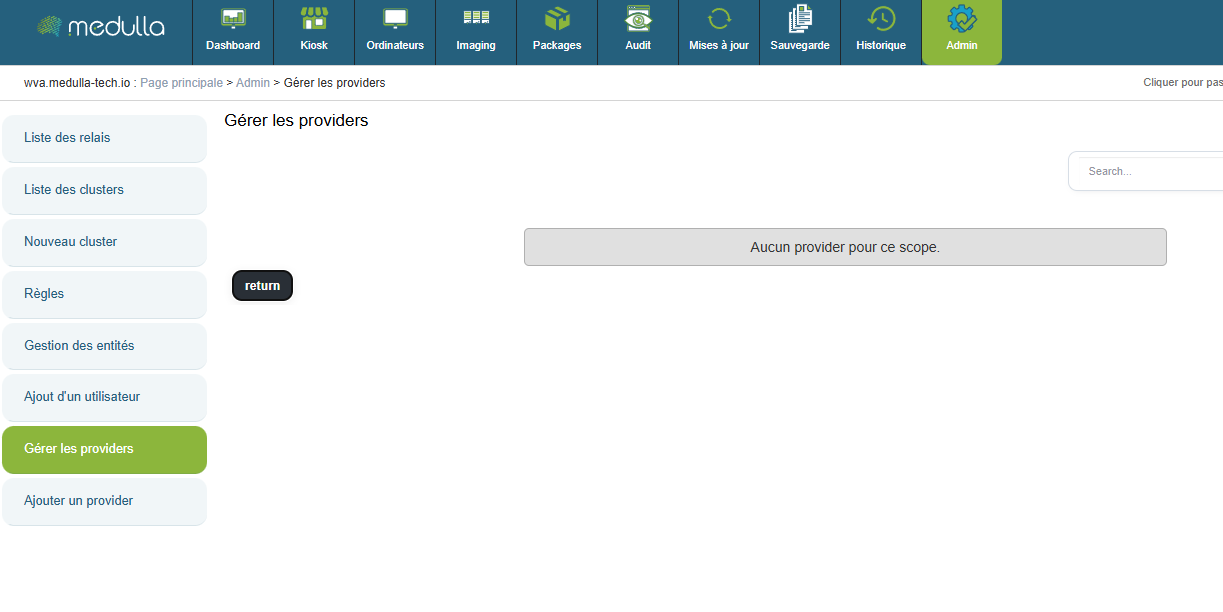
Here you will find a list of already configured OIDC providers that can be modified.
Create an OIDC configuration
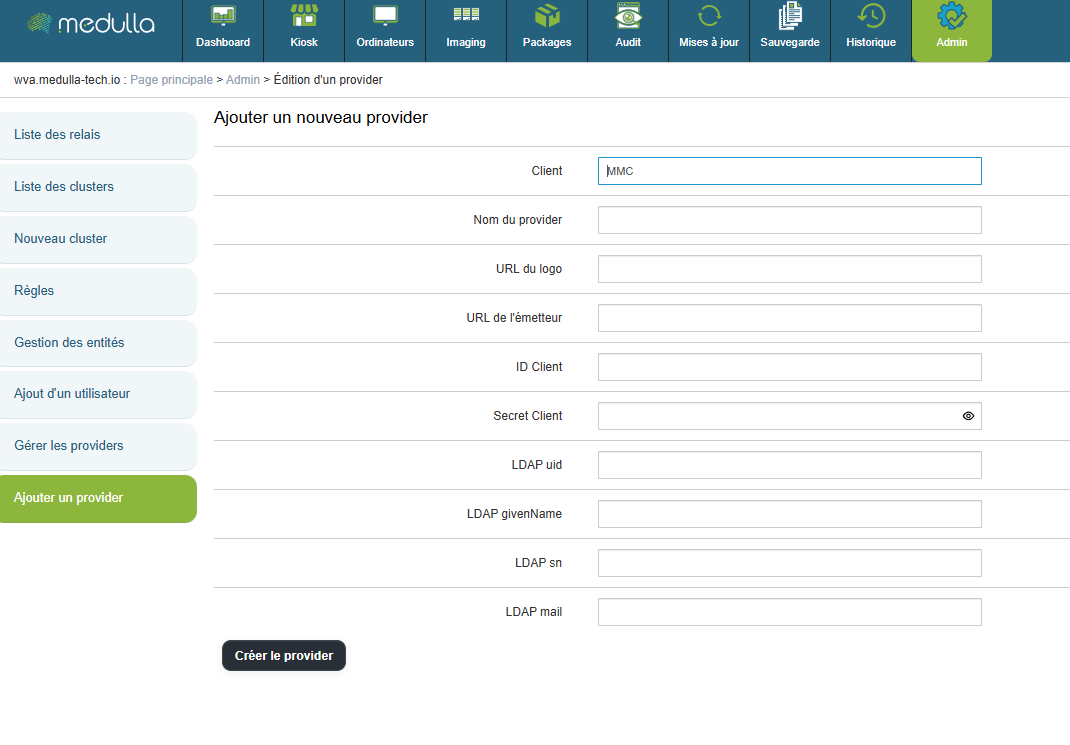
"Provider Name" will be the title displayed on the home page.
"Logo URL" is the web link used to set a logo for the OIDC login button.
"Issuer URL" is the web link that redirects to your OIDC.
"Client ID" is your OIDC's identifier.
"Client Secret" is the password for your OIDC.
- (Optional)
"LDAP uid" corresponds to the mapping of the uid by your OIDC
"LDAP givenName" corresponds to the mapping of the givenName in your OIDC
"LDAP sn" corresponds to the mapping of the sn in your OIDC
"LDAP mail" corresponds to the mapping of the email address in your OIDC
Then click the "Create Provider" button to enable logging in via an OIDC on your platform.
DNS and Medulla Relay views in the DMZ
Since the Medulla agent configuration is unique across the entire network, it supports only a single domain name. To allow machines to reach the server from both the private network and the outside via this single address, the use of a single domain name coupled with DNS views (Split-Horizon) or a Round-Robin is required.
DNS Views
Principle
A DNS view allows different responses to be provided for the same name depending on the origin of the request.
- Internal workstations → internal Medulla server
- External workstations → Medulla relay in the DMZ
Benefits
- Only one DNS name to configure
- No configuration differences on the workstations
- The internal Medulla server is not exposed
- Clear and secure architecture
Key points
DNS views automatically route endpoints to the correct Medulla access point, while maintaining a single name and simple configuration.
Reference article on Bind9: https://kb.isc.org/docs/aa-00851
Round-Robin
Additionally, if you do not wish to configure DNS Views, you can opt for an alternative solution by implementing a Round-Robin mechanism. This mechanism distributes requests across multiple IP addresses associated with the same domain name, ensuring a balanced distribution of connections.
To do this, you need to follow two steps:
- Define the internal IP address of the main Medulla server.
- Define the public IP address of the DMZ relay server.
Filter machine types by GLPI ID
For the filter, in the main section of /etc/mmc/plugins/glpi.ini.local, add:
filter_on = <criterion>
#Display only computers that match one of these filters:
* state
* type
* entity
* autoupdatesystems_id#Each filter may contain a list of values separated by a pipe
#Filters are IDs separated by spacesi.e. state=1 type=2|3|7 entity=2|5
filter_on = state=3
Your GLPI with Read-Only User
Medulla requires the creation of specific views in the GLPI database to function properly.
GLPI Read-Only
If you provide us with a user who has read-only access to your GLPI database, you will need to manually apply an Medulla. This file contains the queries needed to create the required views.
Here is the link to the SQL file:
https://dl.medulla-tech.io/nc/glpi-100.sql
GLPI Write Access
If you allowwrite access to your GLPI database, during installation.
.
Disable convergence for the Extract drivers package
Go to the Medulla server.
Edit the files:
- /etc/pulse-xmpp-agent-substitute/registeryagent.ini
- /etc/pulse-xmpp-agent-substitute/registeryagent.ini.local
Modify the relevant parameter:
[extractdrivers]
# Add the ability to enable or disable the extraction driver mechanism
# Accepted values: 0, false, False
# Accepted values: 1, true, True
activate=0
Save the files.
Restart the service:
systemctl restart pulse-xmpp-master-substitute-registration.serviceConfiguration Guide: OIDC Authentication and User Synchronization
If you are using anon-premises infrastructure and have chosen authentication via the OIDC (OpenID Connect) protocol, it is essential to understand how user accounts are routed and managed between your identity provider and the GLPI interface, especially if the latter is empty of users (having been freshly installed alongside Medulla).
1. Understanding the Authentication Flow
In this architecture, access management follows a specific path:
-
Storage: Your OIDC users are provisioned in the Medulla server’s local LDAP.
-
Authorizations (ACL): Although authentication is managed by OIDC, access rights and permissions (profiles) are controlled directly within GLPI.
Sign of a synchronization issue: If, after logging in via OIDC, you land on a blank GLPI page or one without menus, this means your account has not yet been imported into the GLPI database. Without this step, the system cannot assign you a profile or access rights.
Adding users to GLPI when logging in via OIDC is now automatic if:
- GLPI is installed by default with Medulla
- Your GLPI is accessible in read-write mode
2. Manual synchronization procedure
To activate your users in GLPI, you must establish a connection with the local LDAP directory. Here are the steps to follow:
Step A: Access the linking interface
-
Log in to GLPI with a local administrator account.
-
Go to the Administration > Users menu.
-
Click the LDAP Directory Link button.

Step B: Import accounts
-
Click the Import New Users link.
-
Click the Search button to list the users in the Medulla LDAP directory.
-
Select the desired users (or all of them) and confirm the synchronization.
Increase the connection timeout to the interface
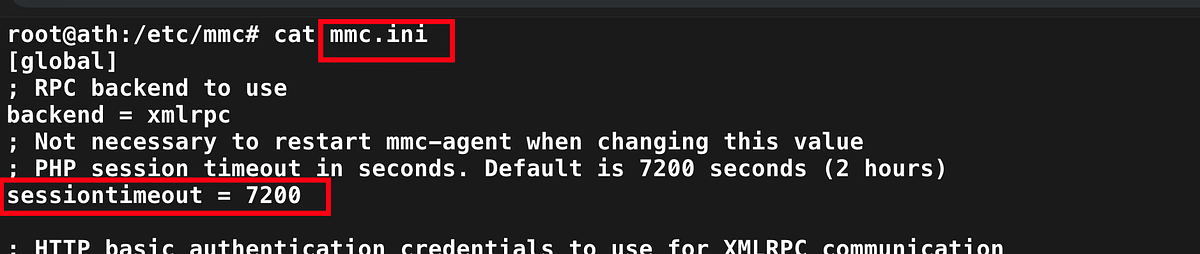
Go to the /etc/mmc/mmi.ini file
Change the sessiontimeout value. (This is in seconds)
Activation Support / WSUS / CVE
Applies to: Medulla – Support / WSUS / CVE
Version: 5.4.3 or later
Environment: On-Premise
Category: Support
After updating your Medulla installation, additional steps are required to enable support.
Please retrieve the following file from your server:
/etc/mmc/plugins/security.ini.local
This file must then be sent to your sales representative.
This step enables your access to support and related services.
Change the server's FQDN
Download the script from this link:
https://dl.medulla-tech.io/nc/rename_fqdn_and_protocol.py
chmod +x rename_fqdn_and_protocol.py
To view the script's options:
./rename_fqdn_and_protocol --help
Change the server's FQDN
To change medulla.mydomain.lan to medulla.mydomain.fr, here is an example of how to use the command:
./rename_fqdn_and_protocol --old-fqdn medulla.mydomain.lan --new-fqdn medulla.mydomain.fr
Change the protocol
It is also possible to change the protocol from HTTP to HTTPS in the URLs at the same time:
./rename_fqdn_and_protocol --old-fqdn medulla.mydomain.lan --new-fqdn medulla.mydomain.fr --new-protocol https
Regenerate the agent
If the workstations also need to communicate directly with the new FQDN, you can regenerate the agent with the new FQDN:
./rename_fqdn_and_protocol --old-fqdn medulla.mondomaine.lan --new-fqdn medulla.mondomaine.fr --update-agent-conf
For more information, and if you have a Medulla support contract, contact support@medulla-tech.io
Change the SSH port between Server and Client
Download the scripts from these links:
https://dl.medulla-tech.io/nc/change_ssh_port_on_agent.py
https://dl.medulla-tech.io/nc/change_ssh_port_on_server.py
chmod +x change_ssh_port_on_agent.py
chmod +x change_ssh_port_on_server.py
To view the script options:
./change_ssh_port_on_agent.py --help
./change_ssh_port_on_server.py --help
You must change the port using both scripts
The port must be the same in both scripts
Change the port on the server
To change port 22 to port 2002, here is an example of how to use the command:
./change_ssh_port_on_agent.py --new-ssh-port 2002
./change_ssh_port_on_server.py --new-ssh-port 2002
The agent will be regenerated after running the "change_ssh_port_on_agent.py" script; you must then redeploy the agent to your workstations.
GLPI - Connect an external GLPI
Applies to: Medulla/GLPI
Medulla version: all
GLPI version: 10.0.x
Environment: On-Premise
Category: Medulla
Prerequisites
Before configuring the integration between Medulla and GLPI, ensure that the following items are available and properly configured.
Download the script here: https://dl.medulla-tech.io/ma/change_itsm_parameters.py
1. GLPI database access
Create a dedicated MySQL/MariaDB user for Medulla with the following permissions:
- Read-only (`READ ONLY`) or read/write as needed
- Access to the entire GLPI database
2. Network connectivity
Allow communication between the Medulla server and the GLPI database server:
- Port `3306` open (or a custom port depending on your configuration)
3. Creating a GLPI API user
Create a GLPI user dedicated to API calls with a name of your choice:
In GLPI under `Administration > Users`
- Type: standard user (username / password)
- Recommended profile:
- `Read-Only` or `Super-Admin`
- Assignment:
- Root entity
- Recursive mode enabled
Then generate a user API token (`user_token`)
4. Creating a GLPI API client
Create an API client named `MMC`.
In GLPI, go to `Configuration > General > API`
Then generate the application token (`app_token`)
5. Import SQL views into your GLPI database
In your GLPI database, you must import the file downloaded here:
https://dl.medulla-tech.io/nc/glpi-100.sql
---
Using the script
Help command
./change_itsm_parameters.py --help
usage: change_itsm_parameters.py [-h] --url URL --db-host DB_HOST [--db-port DB_PORT] --db-name DB_NAME --db-user DB_USER --db-pass DB_PASS --api-url API_URL [--api-user API_USER] [--api-pass API_PASS] [--readonly READONLY] [--crypt-key CRYPT_KEY] [--inv-forward INV_FORWARD] [--inv-forward-url INV_FORWARD_URL] [--inv-plugin INV_PLUGIN] [--inv-agent INV_AGENT] [--inv-agent-disabled INV_AGENT_DISABLED]
Update ITSM parameters
options:
-h, --help display this help message and exit
--url URL ITSM provider URL
--db-host DB_HOST ITSM provider database host
--db-port DB_PORT ITSM provider database port
--db-name DB_NAME ITSM provider database name
--db-user DB_USER ITSM provider database user
--db-pass DB_PASS ITSM provider database password
--api-url API_URL ITSM provider API URL
--api-user API_USER ITSM provider API user
--api-pass API_PASS ITSM provider API password
--readonly READONLY Whether the ITSM provider database is read-only for Medulla (optional)
--crypt-key CRYPT_KEY
Decoded GLPI crypt key file - base64 /etc/glpi/glpicrypt.key (optional)
--inv-forward INV_FORWARD
Whether to forward inventory data to the ITSM provider (optional)
--inv-forward-url INV_FORWARD_URL
URL to forward inventory data to (optional)
--inv-plugin INV_PLUGIN
Inventory plugin to use - glpiinventory or fusioninventory (optional)
--inv-agent INV_AGENT
Inventory agent to use on the client machine - glpiagent or fusioninventory (optional, required if --inv-forward is true)
--inv-agent-disabled INV_AGENT_DISABLED
Whether to include the inventory agent in the Medulla agent (optional)
Usage examples:
./change_itsm_parameters.py \
--url https://glpi.mon-domaine.fr/ \
--db-host 10.10.0.101 \
--db-port 3306 \
--db-name GLPI \
--db-user medulla_glpi \
--db-pass yJxI40UzO8Jn7dd7K5Yaml \
--api-url https://glpi.mon-domaine.fr/apirest.php/ \
--api-user medulla_APIUSER \
--api-pass fLN1Zomh877obPhk \