Medulla: Getting Started
Get started with Medulla for the first time with ease. This visual guide will help you perform your first tasks in Medulla: logging in, adding a device to the list, creating a package, and deploying that package to a device.
- On-Premises
- How to log in to Medulla
- Dashboard
- Adding a computer in Medulla
- Creating your first package
- Package deployment
- Track the audit of a deployment
- SaaS
On-Premises
How to log in to Medulla
To access Medulla’s features, you must log in with your credentials. This step ensures the security of your data and personalized access.
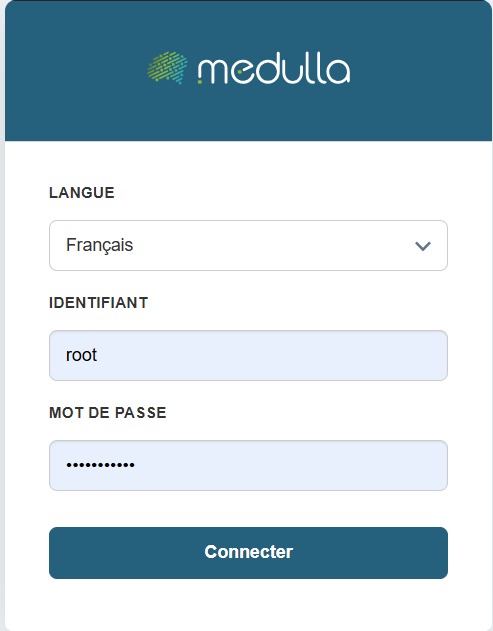
Login Steps
Choose your language
On the login page, select your preferred language from the dropdown menu. The default language is French, but you can change it if necessary.
Enter your username
Enter the username and password for a GLPI or LDAP account, depending on the provisioning method defined during the configuration of your Medulla server.
OR
Log in directly via your OIDC if it is configured.
Enter your password
In the Password field, enter your personal password. Make sure it is spelled correctly: uppercase and lowercase letters are distinguished.
Confirm the login
Click the "Log In" button to access your user account.
For security reasons, avoid saving your password on shared devices.
If you have trouble logging in, contact your organization’s technical support
Dashboard
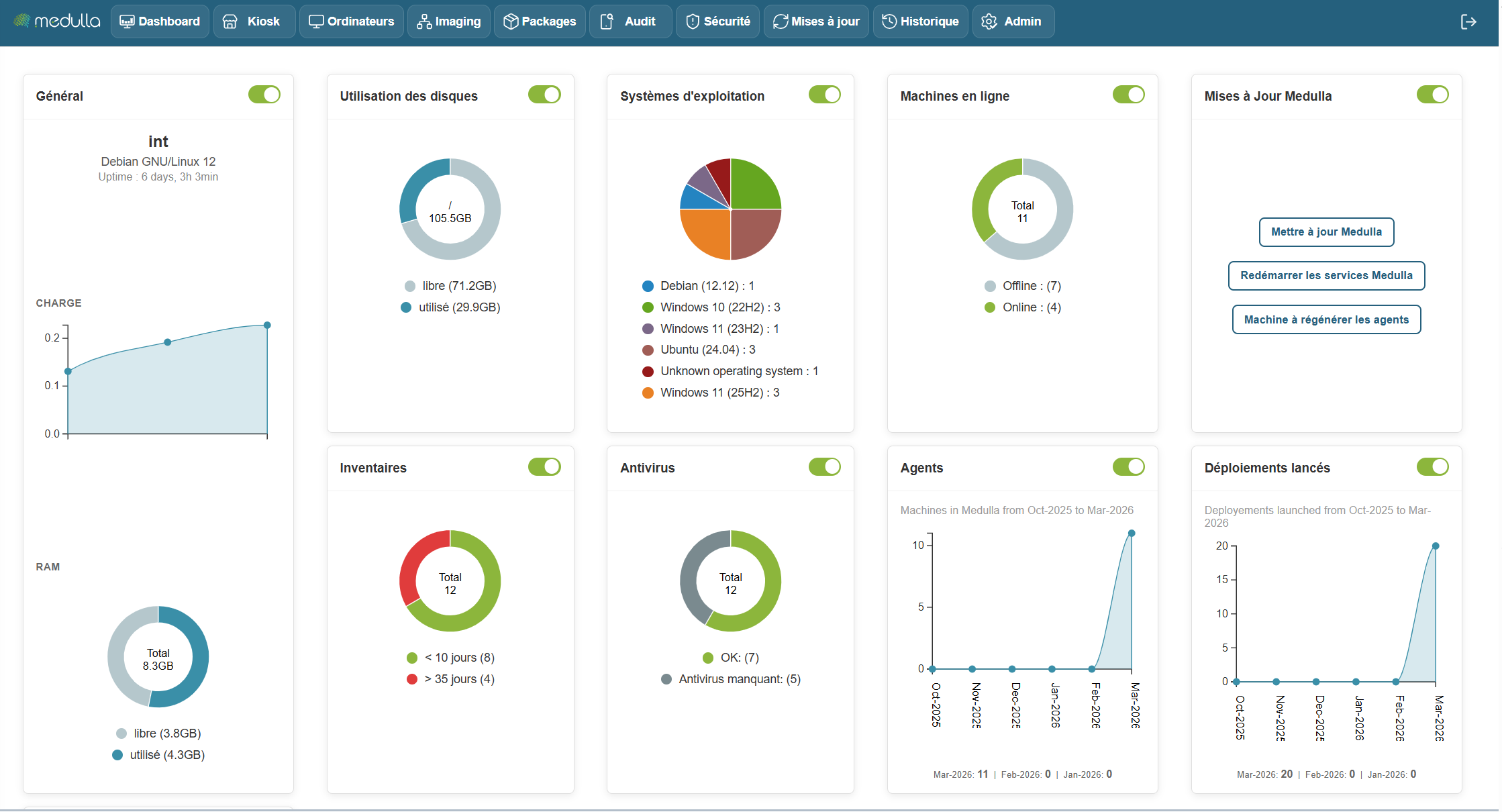
The Medulla dashboard allows you to monitor the real-time status of your infrastructure using customizable widgets. You can move, resize, and arrange the widgets as you wish. Each widget also has a button to show or hide it, depending on your needs.
Some widgets include dynamic charts for a better understanding of the data, updating in real time.
The following widgets allow you to create static groups directly so you can perform actions on them by clicking:
Inventory Widget, Operating System, Online Machines, Antivirus
Available Widgets
Widgets are organized by category and allow you to view various information about your infrastructure. Here are the main categories:
General
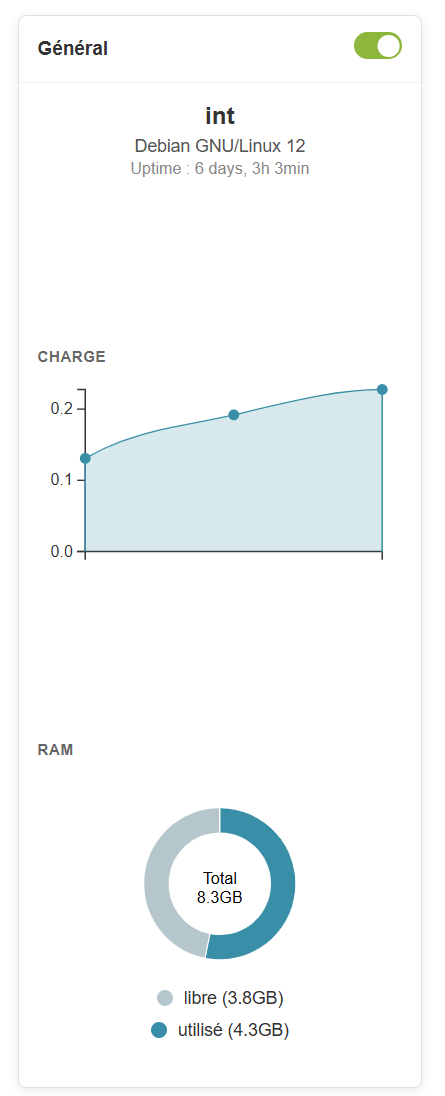
Information provided
-
Server name (example: devdemo.siveo.net on Debian GNU/Linux 12)
-
Uptime (time elapsed since the last system reboot)
-
TotalRAM, available RAM, and used RAM
Customization
This widget can be moved wherever you like, and it is resizable to display more or less information depending on your needs. You can also hide it using the toggle if you don’t need to see this information all the time.
Graphical representation
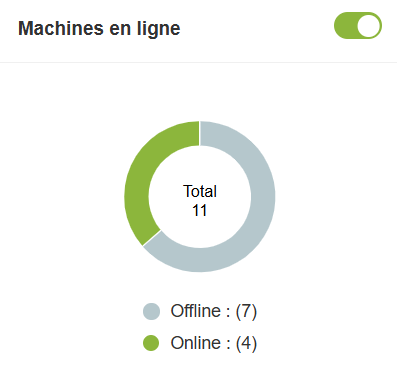
Online machines
Information provided
- Total number of online and offline machines.
Customization
This widget can be moved and resized as you like. The toggle allows you to show or hide it according to your preference.
Graphical representation
Pie chart to visualize the distribution of online and offline machines.
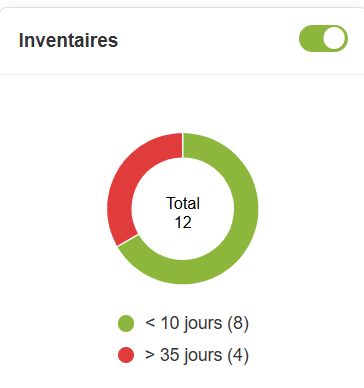
Inventory
Information provided
- Total number of items in the inventory and those that haven't been updated in over 10 days.
Customization
The widget is customizable and can be moved and resized. You can also hide it if you don’t need it.
Graphical representation
A pie chartdisplays the items in the inventory and highlights those requiring an update, providing an overview of the inventory’s status
In summary, the Dashboard is your centralized hub for managing and monitoring the status of your IT infrastructure. It is designed to be flexible and responsive, providing an overview of the performance of your machines and resources, while allowing you to react quickly to any alerts or necessary updates.
With this set of tools and graphical visualizations, the Dashboard gives you optimal control to manage your systems efficiently, while providing a clear and detailed view of your entire IT environment.
Adding a computer in Medulla
The Medulla agent can be downloaded from
http://medulla.domaine.lan/downloads/win/Medulla-Agent-windows-FULL-latest.exe
The Medulla agent can be installed manually or in silent mode:
"Medulla-Agent-windows-FULL-latest.exe /S"
The installation process will continue after the installation is complete; it will install all dependencies.
It is complete when the computer appears in Medulla in blue (online).

Medulla Agent
By default, we provide a global agent for Medulla (as explained in this post).Entity management per workstation is handled via GLPI.
However, if you wishto benefit, it is also possible to. This option, butif it meets your needs. To view agents by Entity:Entity Management
Creating your first package
Link to the complete package module:
https://docs.medulla-tech.io/books/medulla-guide-dutilisation-pas-a-pas/chapter/chapitre-8-packages
-
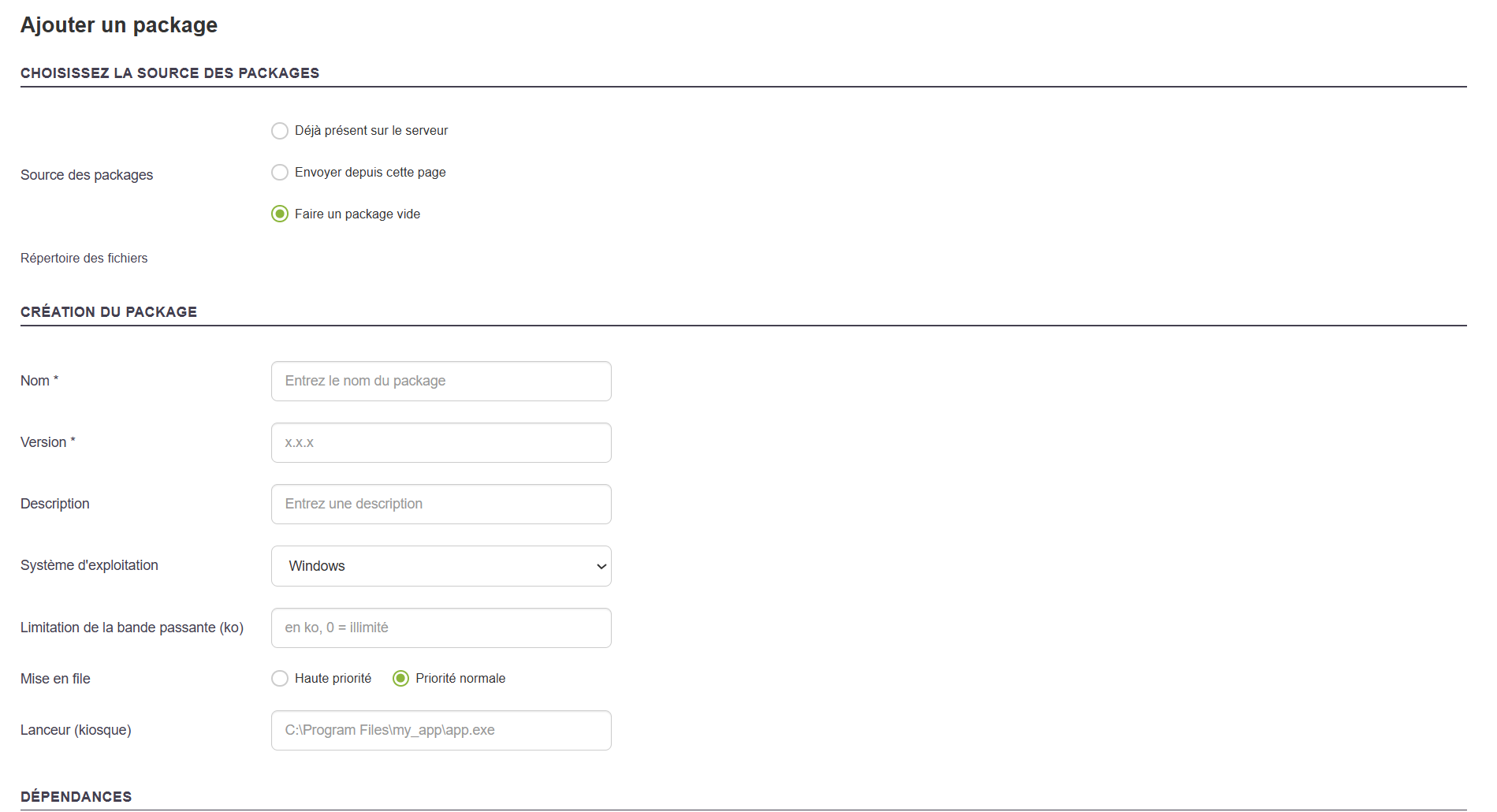
Creating a package involves defining an action (installation, uninstallation, script, etc.) that will be deployed on one or more workstations. The creation form allows you to precisely configure the package’s behavior and its execution options.
Here we will create a simple package, without adding a workflow, solely to install a simple application such as Notepad++.
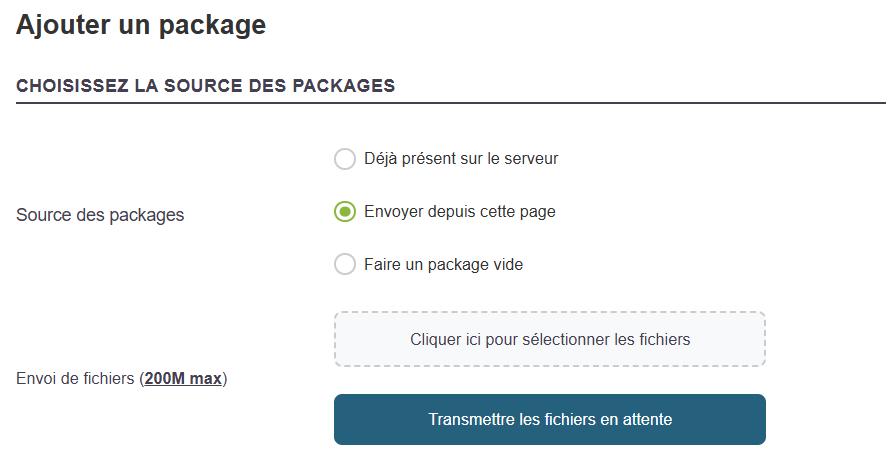
Next, select the source of the files to be used in the package. Four options are available:
- Already on the server
- Upload from this page
- Create an empty package
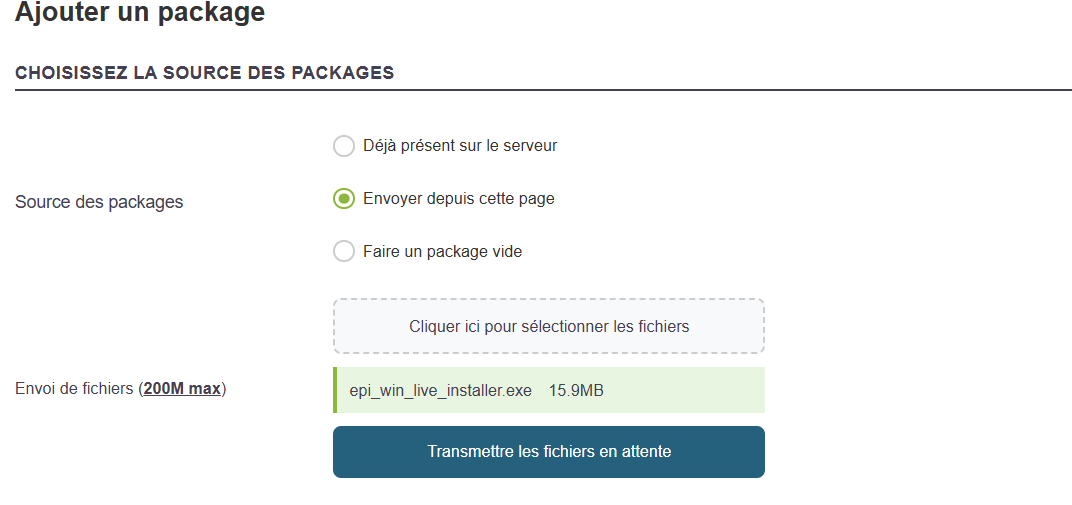
Use a Notepad++ installer, for example, then click:
-
Upload from this page
Import the installation files directly from your computer. - Don’t forget to click “Send pending files.”
General information to provide
Share
SelectGlobal Packages to make the package visible across the entire platform, for all Entities.
Name
Give the package a descriptive name, for example: InstallNotepad
Special characters (except: _ and -) and accented characters are not allowed.
Version
Specify a version number, e.g., 1.0.0 or the Notepad++ version.
Description
Briefly summarize the purpose of the package.
Operating System
Select the target OS, for example:Windows.
Transfer method
Generally, use pushrsync (recommended): Server -> Rsync -> Machine.
Link to inventory
Enable this option to allow tracking of the package after installation via the GLPI inventory, if desired.
As you type the first three letters, autocomplete will activate.
Auto-completion is based on the existing inventory in GLPI.
You can add custom actions to the package, depending on your needs:
Here, our wizard will automatically determine, based on rules, the correct command to run the installation file to install the application in silent mode.
-
Run a command or script (When adding a file to the "Package Source" package, our wizard automatically adds the correct command to run the setup file and silently install the application)
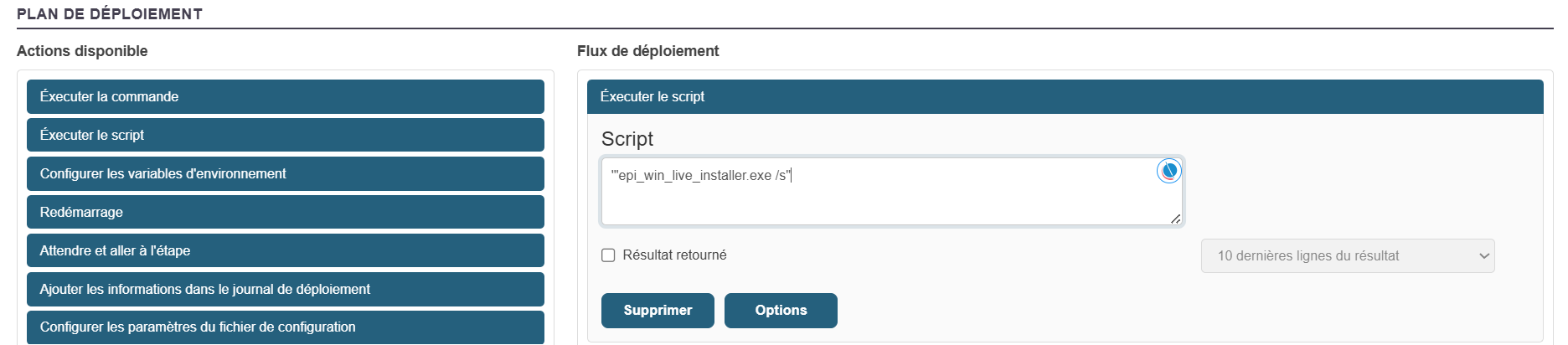
Once all sections have been configured and verified
ClickAddto save the package.
It will then be accessible from the "Packages > Package List" library for use in a deployment.
It will temporarily appear in the "Pending Packages List" if you have relays. This list shows the progress of the package synchronization across all your relays, if you have any.
For a complete guide on creating packages: Complete Package Creation
Package deployment
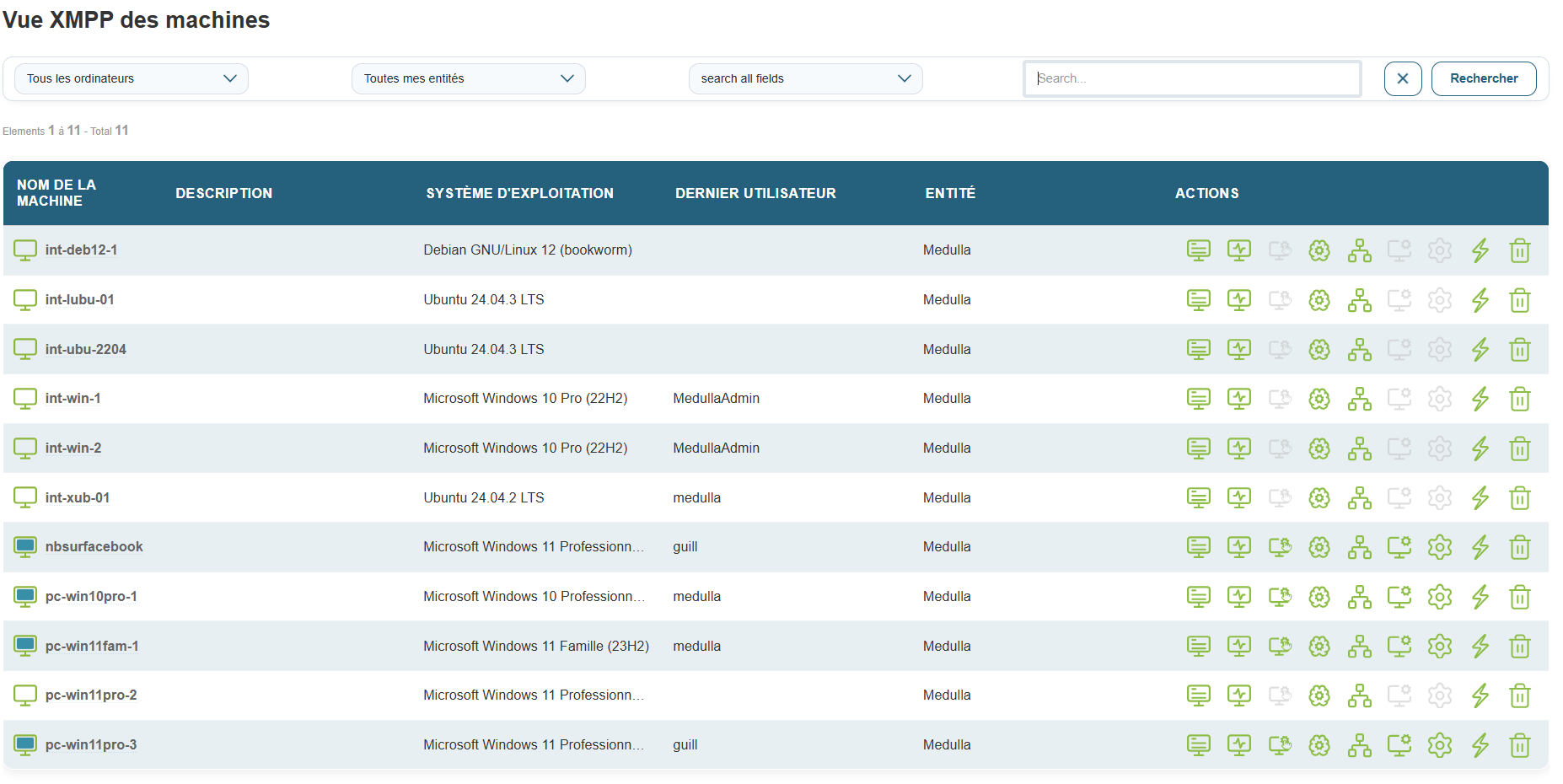
Here we will deploy the package created earlier.
Go to the Computer view and select a workstation. Click the deployment button:
 Software Deployment - Remote software installation or update.
Find the new package you created earlier in the package list and click the instant deployment icon:

 Launch Action - Deploys the package to the previously selected workstation.
When you start a deployment, you are automatically redirected to the Deployment Audit page.
Otherwise, go to the "Audit" view; a new row will appear, allowing you to track the progress of the deployment you just performed.
See the page: Deployment Audit
Track the audit of a deployment
Would you like to view the audit of a deployment? Go to the Audit view in the navigation bar.
Search for your deployment by name, which includes the deployment start date and time as well as other useful information.
On the row for your deployment’s audit, on the far right, you’ll find the button that lets you view the full deployment audit: 
You will then be redirected to a new page that includes all the details of the deployment:
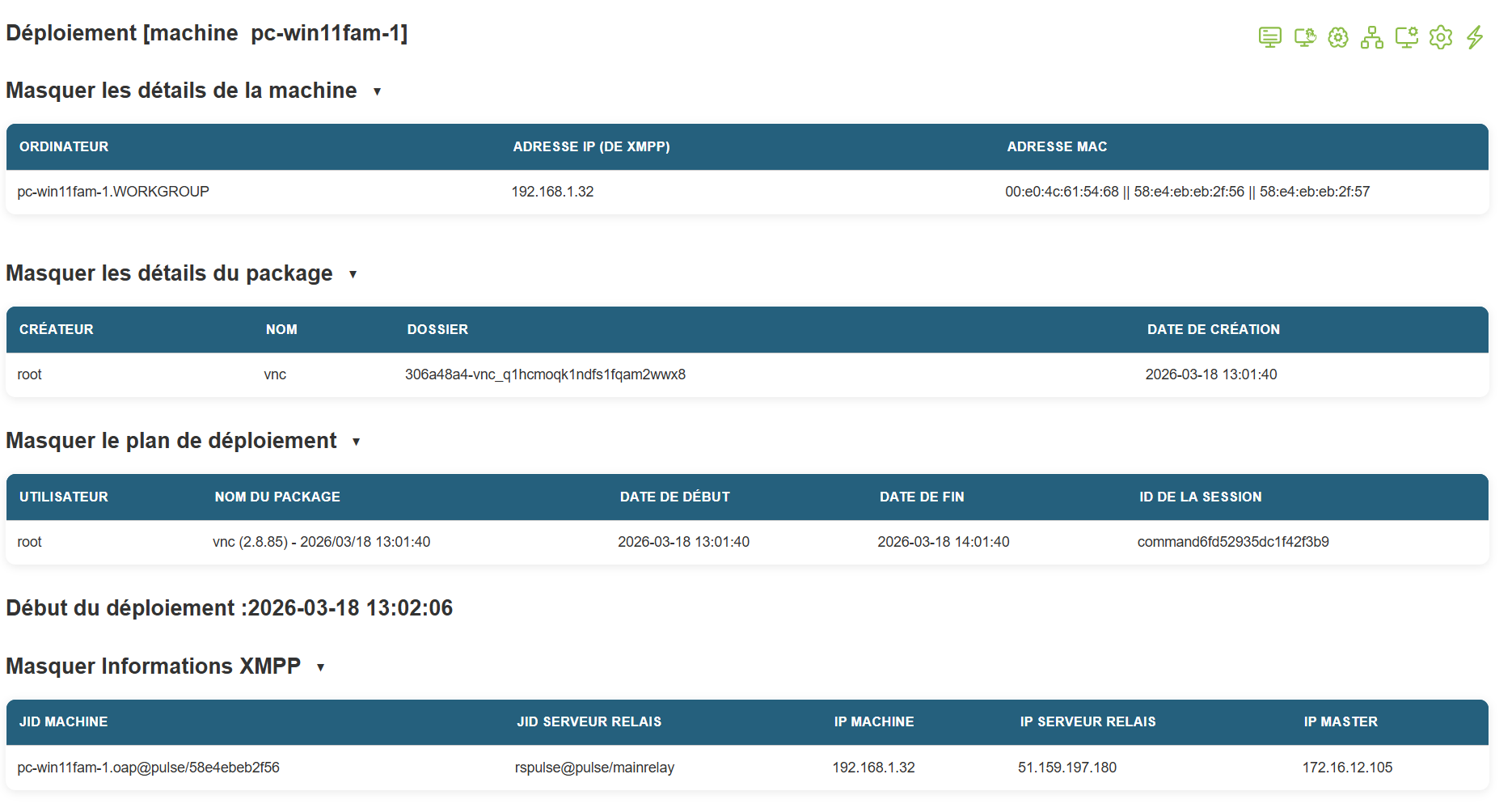
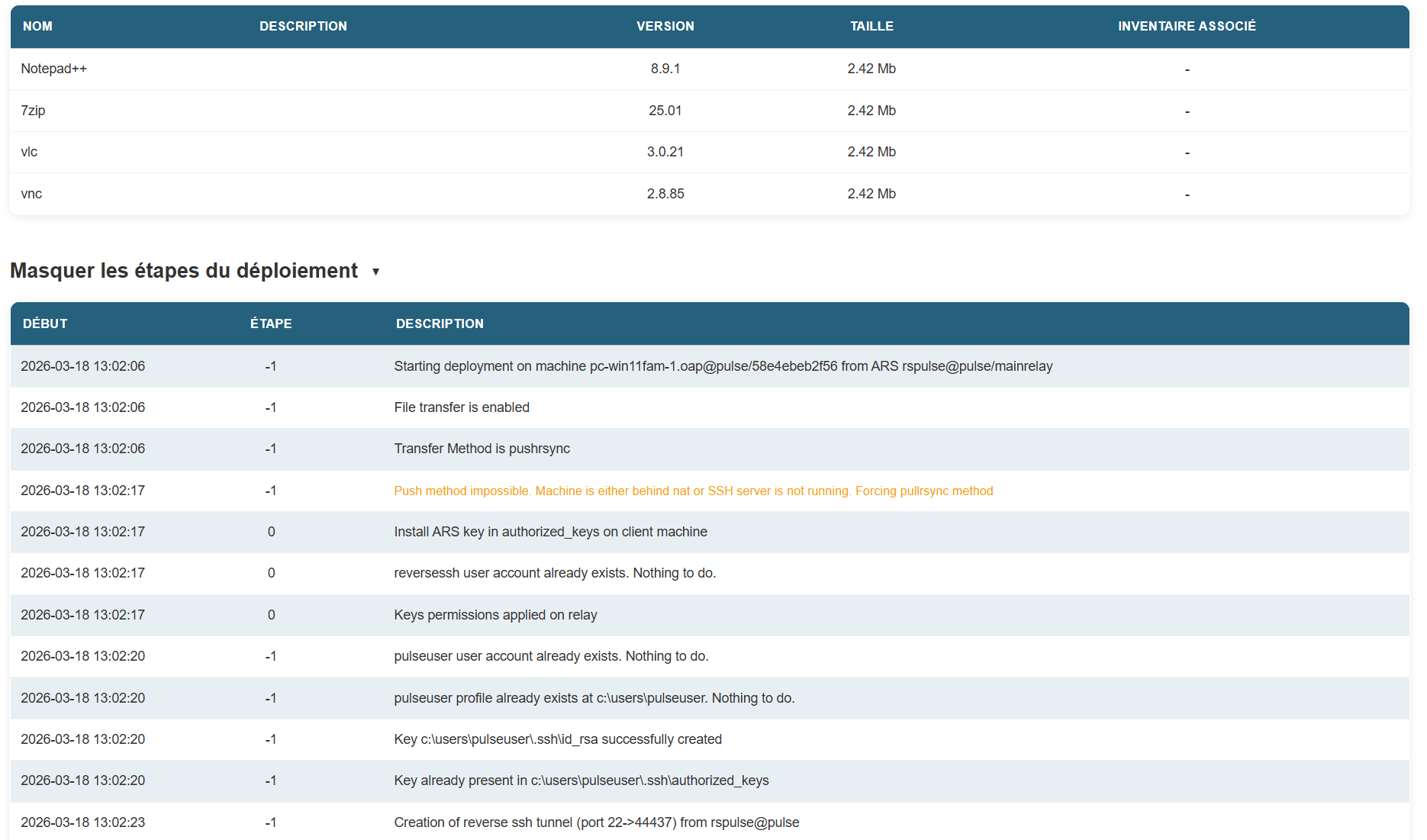
SaaS
How to log in to Medulla
After subscribing to our SaaS offering, you should have received a link to access our platform.
Simply enter your email address there to receive a "Magic Link" that will allow you to log in to your account.
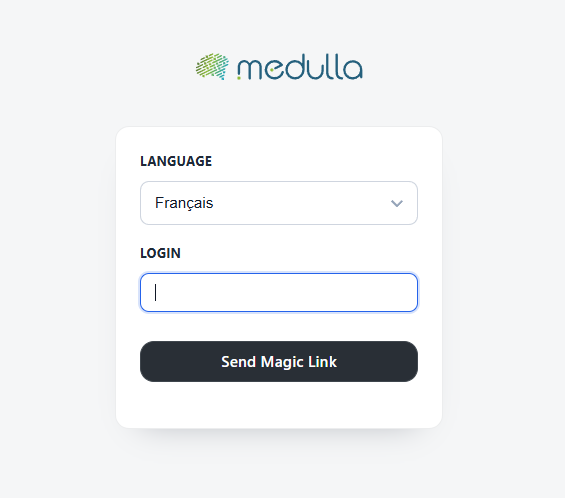
Login Steps
Choose your language
On the login page, select your preferred language from the dropdown menu. The default language is French, but you can change it if necessary.
Enter your username
Before configuring your OIDC, users, and entities, you must log in for the first time using the information provided in the email containing your SaaS contract.
Confirm the login
Click the "Log In" button to access your user dashboard.
For security reasons, avoid saving your password on shared devices.
If you encounter any login issues, contact your organization’s technical support
Dashboard
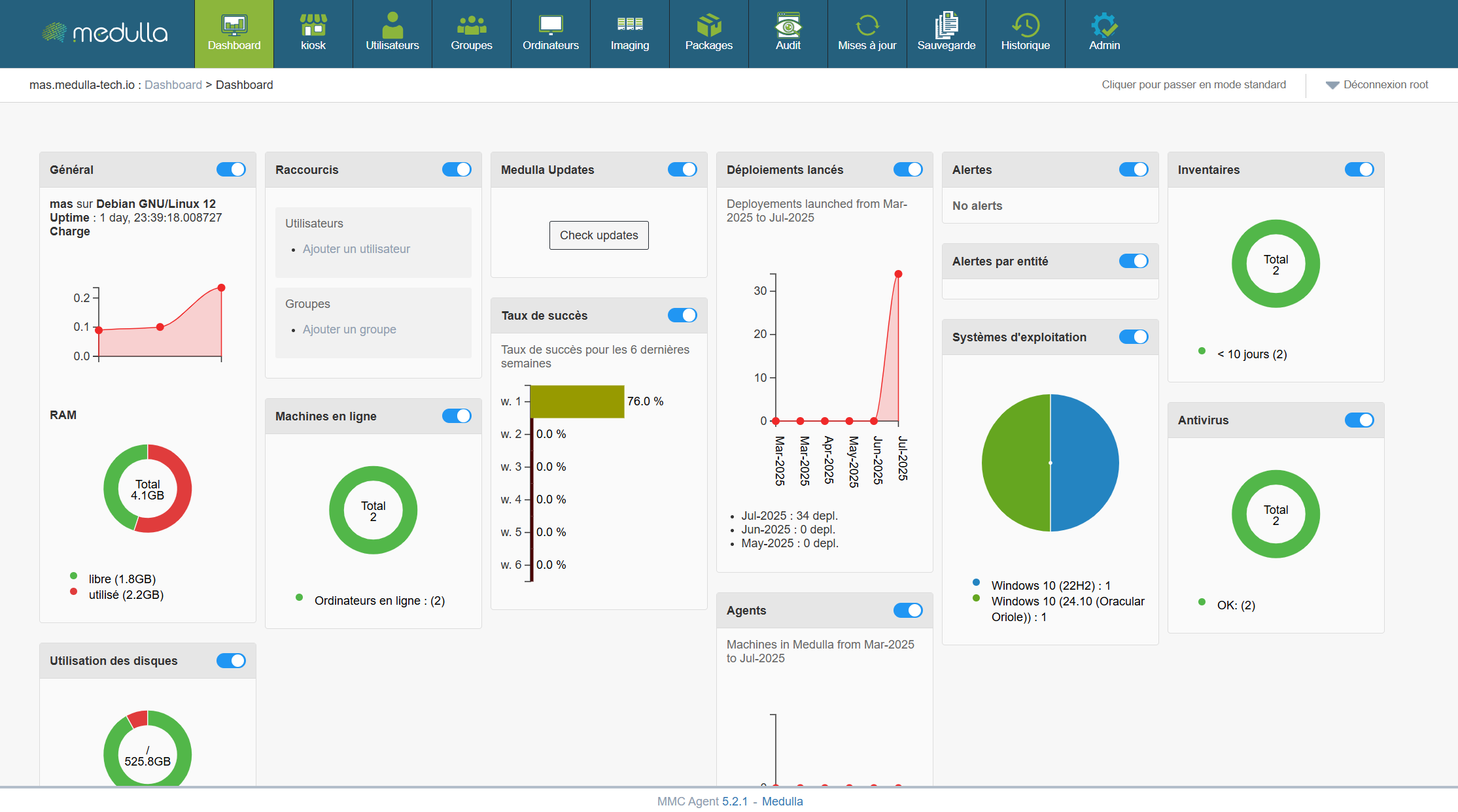
The Medulla dashboard allows you to monitor the real-time status of your infrastructure using customizable widgets. You can move, resize, and arrange the widgets as you wish. Each widget also has a button to show or hide it, depending on your needs.
Some widgets include dynamic charts for a better understanding of the data, updating in real time.
The following widgets allow you to create static groups directly so you can perform actions on them by clicking:
Inventory Widget, Operating System, Online Machines, Antivirus
In summary, the Dashboard is your centralized hub for managing and monitoring the status of your IT infrastructure. It is designed to be flexible and responsive, providing an overview of your machines’ and resources’ performance while allowing you to react quickly to any alerts or necessary updates.
With this set of tools and graphical visualizations, the dashboard gives you optimal control to manage your systems efficiently, while providing a clear and detailed view of your entire IT environment.
Adding a computer in Medulla
Once logged in to your interface, go to the "Admin" > "Entity Management" view.
You can download your agent directly by clicking the  "Download" button in the "Actions" section on the right side of your entity.
Note: Each entity has its own agent, which helps maintain separation between entities.

Important Information
When you install an agent on a Windows machine, it must be restarted; the agent will prompt you to restart the computer.
Once restarted, itmay take up to 5 minutes for your computer to appearin the "Computers" section of your interface .It may take up to 20 minutes for the machine to fully initialize for the first time and appear as"Online" on your interface.

Creating your first package
Link to the complete package module:
https://docs.medulla-tech.io/books/medulla-guide-dutilisation-pas-a-pas/chapter/chapitre-8-packages
-
Creating a package involves defining an action (installation, uninstallation, script, etc.) that will be deployed on one or more workstations. The creation form allows you to precisely configure the package’s behavior and its execution options.
Here we will create a simple package, without adding a workflow, solely to install a simple application such as Notepad++.
Next, select the source of the files to be used in the package. Four options are available:
Get a Notepad++ installer, for example, then click:
-
Upload from this page
Import the installation files directly from your computer. - Don’t forget to click “Submit pending files.”
General information to provide
Share
SelectGlobal Packages to make the package visible across the entire platform, for all Entities.
Name
Give the package a descriptive name, for example: InstallNotepad
Special characters (except: _ and -) and accented characters are not allowed.
Version
Specify a version number, e.g., 1.0.0 or the Notepad++ version.
Description
Briefly summarize the purpose of the package.
Operating System
Select the target OS, for example:Windows.
Define the technical deployment details
Transfer method
Generally, use pushrsync (recommended): Server -> Rsync -> Machine.
Link to inventory
Enable this option to allow tracking of the package after installation via the GLPI inventory, if desired.
As you type the first three letters, autocomplete will activate.
You can add custom actions to the package, depending on your needs:
Here, our wizard will automatically determine, based on rules, the correct command to run the installation file to install the application in silent mode.
-
Run a command or script (When adding a file to the "Package Source" package, our wizard automatically adds the correct command to run the setup file and install the application silently)
Once all sections have been configured and verified
ClickAddto save the package.
It will then be accessible from the "Packages > Package List" library for use in a deployment.
Package deployment
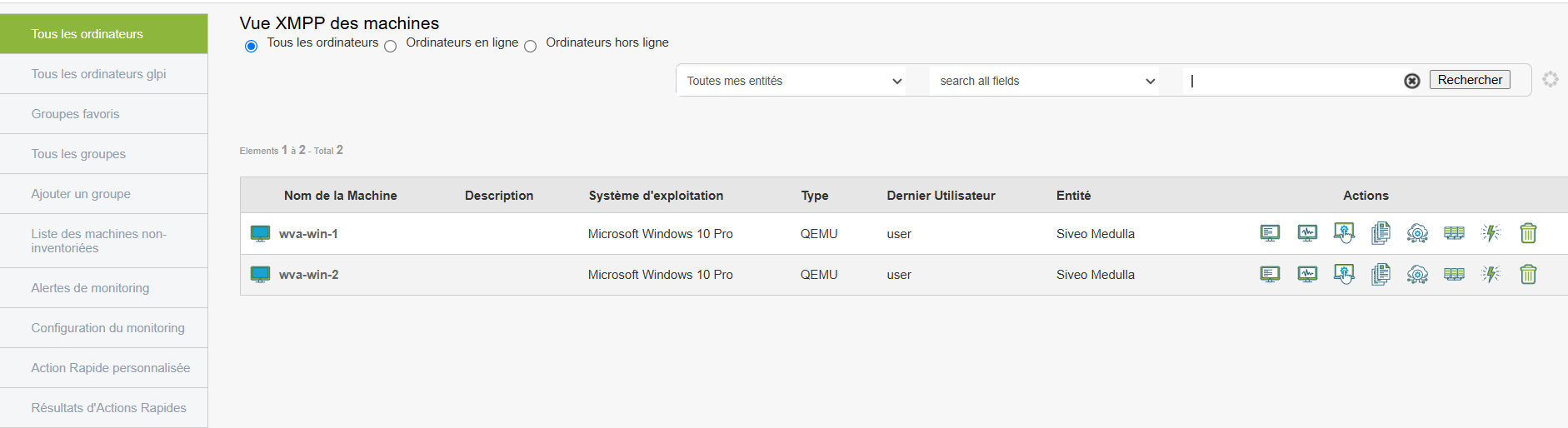
Here we will deploy the package created earlier.
Go to the Computer view and select a workstation. Click the deployment button:
 Software Deployment - Remote software installation or update.
Find the new package you created earlier in the package list and click the instant deployment icon:

 Run Action - Deploys the package to the previously selected workstation.
Go to the "Audit" view; a new row will appear.
A new row appears, allowing you to track the progress of the deployment you just performed.
Track the audit of a deployment
Go to the "Audit" view; a new line will appear.
A new row appears, allowing you to track the progress of the deployment you just performed.
Create my first entity

An initial entity named after your organization will be created.
To create your first sub-entity, go to the "Admin" module.
Once in the "Admin" module, navigate to the "Entity Management" submenu on the left.

Click the "  " button on your entity's row to add a sub-entity.

You can enter the name of your first entity belonging to your organization here; once the name is entered, click the "Create Entity" button .

You are now able to create entities and sub-entities. There is no limit to the number of entities you can create.
A user who is part of the highest entity in the hierarchy can manage lower-level entities; however, the reverse is not possible, even for the entity’s Super-Admin.
Two entities at the same hierarchical level remain isolated: they have access only to their own information and cannot under any circumstances view that of others, even if they are at the same level.
Add your first user

Now that you have created your first entity, it is time to define a user for it.
Go to "Add a User" in the left-hand menu.

Here you have the choice between several profiles:
- Super-Admin
- Admin
- Technician
Manage them as you see fit.
You can then choose:
This user's entity
Their recursion, whether they can see entities subordinate to them. (default: Yes)
Then enter their login and personal information (authentication will be via email/password).
- Password
- First Name
- Last Name
- Phone number
Finally, click the "Create a new user" button.
Set up your first OIDC provider
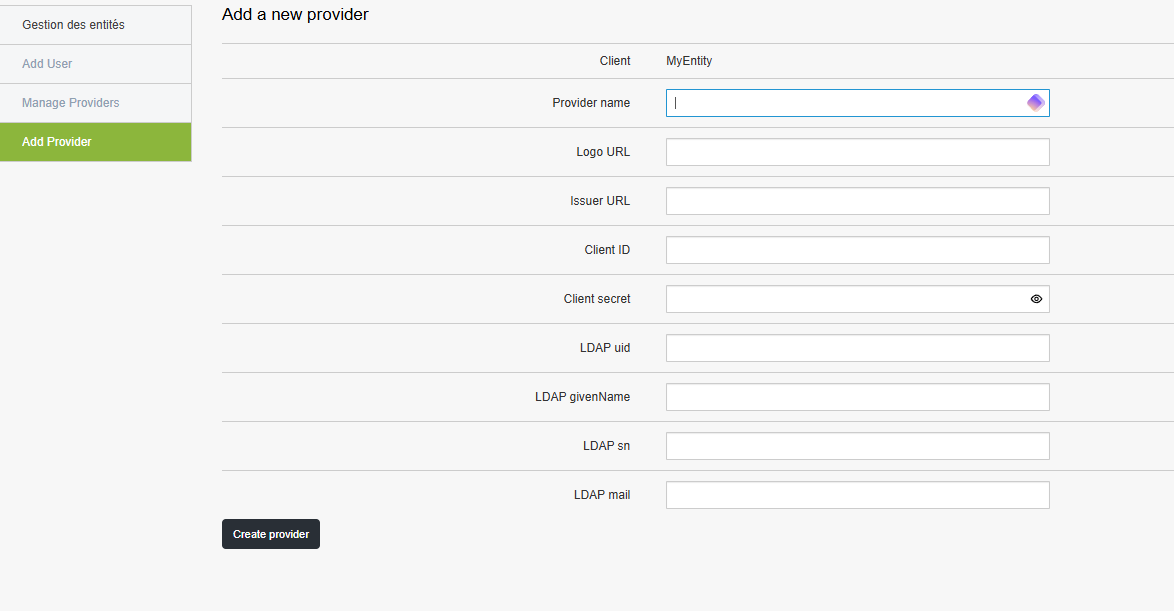
If you do not wish to authenticate using standard users, you can configure one or more providers (OIDC, SSO).
The "provider name" field is for display purposes only; the logo is optional.
Then enter the provider configuration:
- URL
- ID
- Secret
You can then configure the LDAP attributes.
- uid
- givenName
- sn